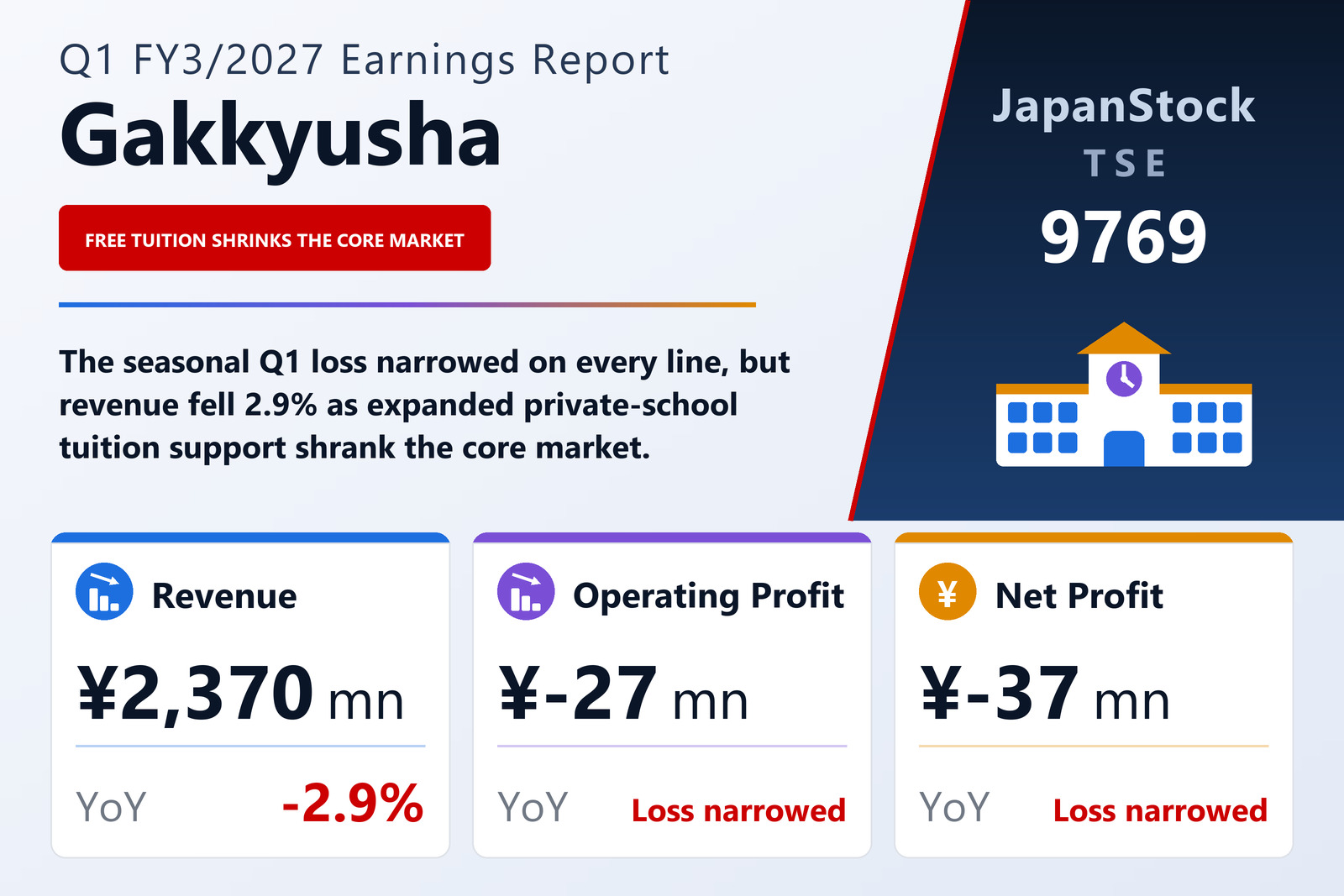
A subsidy for private high schools has cut into a business built on public-school entrance exams
GAKKYUSHA CO., LTD. (TSE: 9769), the Tokyo-based operator of the ena cram-school network, published consolidated results for the three months to June 30, 2026 on August 13, 2026 under Japanese GAAP. Revenue fell 2.9% to ¥2,370 million, the operating loss narrowed to ¥27 million from ¥36 million, the ordinary loss to ¥12 million from ¥23 million, and the net loss attributable to owners of the parent to ¥37 million from ¥66 million — a loss of ¥3.45 per share against ¥6.12. Comprehensive income was a loss of ¥17 million against ¥93 million.
The filing is unusually direct about why revenue fell. Tokyo's expansion of effective free tuition at private high schools, joined from April 2026 by an expansion of the national government's own private high-school tuition support, has reduced the number of pupils aiming at metropolitan public junior-high and senior-high schools — and preparing exactly those pupils is what the company calls its own strength. That is not a demand cycle. A subsidy that lowers the price of the private alternative works directly against a cram school whose franchise is the public-school entrance examination, and the filing names no offsetting factor in the domestic business. The industry backdrop it sets out is structural too: a school-age population shrinking with the birth rate, university-entrance reform, the spread of ICT teaching and now generative AI, and competitors arriving from outside the sector.
Every education division shrank except the overseas one
Education revenue was ¥2,207 million, down 3.5%. The ena 小中学部 primary and junior-high division fell on the same shortfall of pupils aiming at Tokyo's public schools. ena 個別, the one-to-one tuition arm, fell because classroom closures carried out in the previous year left it with fewer classrooms and fewer pupils. The university-entrance division — ena 看護 nursing, ena 美術 art and ena 高校部 — fell for the same reason, after the prior year's closure of ena 看護 classrooms. Only the GAKKYUSHA USA group (GAKKYUSHA U.S.A. CO., LTD., GAKKYUSHA CANADA CO., LTD., ENA EUROPE GmbH and 株式会社学究社帰国教育) grew, with pupil numbers running to plan. The group is shrinking at home, growing abroad, and closing classrooms deliberately. Segment revenue here is stated before elimination of inter-segment transactions, as the filing specifies, and the table follows that basis.
Real Estate, the group's leased property, was ¥43 million, up 3.2%, with rental income described as broadly stable. Other — internet delivery of examination and education information, advertising and a staffing service — was ¥124 million, down 20.2%, and that figure needs reading carefully. On the same basis, Other's external revenue actually rose 6.4%, to ¥123.1 million from ¥115.7 million; what collapsed was its intra-group revenue, from ¥39.8 million to ¥0.9 million, after the company reviewed its transactions with group companies. Underneath, advertising to ordinary corporates fell while advertising to school corporations rose on new apps and banner and production deliveries, and the staffing arm — a school-visit service — grew as it spread into Kansai and other regions and into universities, lifting the number of contracted schools. Separately, the reportable-segment definitions changed this quarter: one consolidated subsidiary moved from Other into Real Estate following a review of internal management classifications. The prior-year figures are restated onto the new basis, so the comparisons above are like-for-like, and the scope of consolidation itself did not change.
The loss narrowed on cost — and Other ate most of the gain
Cost of sales fell 3.5% to ¥1,827 million and selling, general and administrative expenses 2.3% to ¥570 million, which the company attributes to the prior year's classroom consolidation and closures and to a group-wide efficiency drive; gross profit therefore fell only 0.8%, to ¥542 million, on a 2.9% revenue decline. Yet the operating loss improved by just ¥9.0 million, and the segment note shows where the rest went. Education's segment loss narrowed ¥27.6 million, to ¥66.7 million from ¥94.3 million. Real Estate was flat at ¥19 million. But Other's segment profit halved, to ¥18.5 million from ¥37.2 million — a fall of ¥18.7 million, alongside the ¥38.9 million of intra-group revenue that disappeared from it. More than two-thirds of the education improvement was consumed inside the group.
Below the operating line, last year's impairment is the difference
The net loss narrowed about three times as much as the operating loss, and the extraordinary items are the reason. Total extraordinary losses fell to ¥27.0 million from ¥73.3 million: the prior year's ¥50.4 million impairment in the Education segment, booked against the classroom closures, was replaced by one of ¥5.3 million, and a ¥20.3 million loss on cancellation of lease contracts became ¥0.9 million, although loss on disposal of fixed assets rose to ¥20.7 million from ¥2.6 million. Extraordinary gains fell to ¥1.4 million from ¥15.1 million, last year's figure having included ¥14.7 million of compensation received. The pre-tax loss therefore improved ¥43.8 million, to ¥38.1 million from ¥81.9 million — but the tax line, a credit of ¥15.4 million a year ago, was a credit of only ¥0.6 million this time, so ¥14.8 million of that improvement never reached the bottom line. Interim tax here is computed by applying an estimated full-year effective rate to pre-tax profit, so on a loss this small the tax charge is volatile by construction.
A year's tax and dividend left the cash balance; camp buildings arrived
Total assets fell ¥1,253 million to ¥11,312 million. Current assets fell ¥1,481 million to ¥2,305 million, with cash and deposits alone down from ¥3,417 million to ¥1,922 million. The uses are visible on the other side of the sheet: income taxes payable fell to ¥50 million from ¥508 million, and retained earnings fell ¥613 million, to ¥6,155 million from ¥6,769 million, on the year-end dividend and the quarterly loss. Advances received — tuition billed ahead of the teaching — fell to ¥856 million from ¥1,118 million, though that compares a June quarter-end with a March year-end and the filing gives no like-for-like reading of it. Liabilities fell ¥660 million to ¥3,731 million and net assets ¥593 million to ¥7,580 million; because assets fell faster than equity, the equity ratio rose to 67.0% from 65.0%. Equity attributable to owners of the parent was ¥7,578 million against ¥8,171 million.
Fixed assets rose ¥227 million to ¥9,006 million, and this is the one place the quarter spent forward. Buildings and structures, net, rose to ¥4,134 million from ¥4,018 million and tools, furniture and fixtures, net, to ¥234 million from ¥153 million, against quarterly depreciation of only ¥112 million. The company opened a sixth building at its Kiyosato residential camp (清里合宿場) and increased the accommodation capacity of the third building at its Mt. Fuji camp (富士山合宿場), responding to rising demand for the intensive residential courses it calls one of its strengths, and says it expects those investments to lift revenue from the second quarter onward. A company closing classrooms in its weakest divisions is at the same time adding beds in its strongest.
A 2.9% decline inside a year guided to grow 12.1%
Full-year guidance is unchanged from the forecast published on May 15, 2026: revenue of ¥14,656 million (+12.1%), operating profit of ¥3,235 million (+11.4%), ordinary profit of ¥3,240 million (+7.8%) and profit attributable to owners of ¥2,186 million (+18.3%), for earnings per share of ¥201.20. The company says the quarter ran broadly within plan. The reconciliation it offers is seasonal, and it is set out plainly in the filing: the first quarter, when the school year opens, carries the fewest pupils; numbers peak in the third and fourth quarters as the examination season arrives; revenue swells during the spring, summer and winter intensive courses while classroom costs — staff and rent — accrue evenly, so the first quarter books an operating loss by construction and the profit is made from the second quarter on. On those two figures the quarter just reported is 16.2% of the full-year revenue guide, leaving 83.8% to be earned in the nine months that contain the summer and winter courses. Beyond that seasonal shape, the filing does not reconcile a 2.9% decline with a 12.1% annual increase.
The dividend is the other thing worth stating plainly. FY3/2027 is guided at ¥127.00 per share — ¥62.00 at the interim and ¥65.00 at the year-end — against ¥103.00 (¥50.00 and ¥53.00) for FY3/2026, an increase of 23.3%. The filing records no revision to that forecast, so the raise was set in May rather than announced with these results. Against the guided ¥201.20 of earnings per share it is a payout of roughly 63%, and it is being paid by a company that has just reported a quarterly loss and whose cash and deposits fell ¥1,495 million over the three months — both of which the seasonal shape of the year is meant to reverse, and neither of which a first quarter can prove.
| Metric | Q1 FY3/2027 | Q1 FY3/2026 | Change |
|---|---|---|---|
| Revenue (¥ million) | 2,370 | 2,441 | −2.9% |
| Gross profit (¥ million) | 542 | 547 | −0.8% |
| SG&A expenses (¥ million) | 570 | 583 | −2.3% |
| Operating profit (¥ million) | −27 | −36 | loss narrowed |
| Ordinary profit (¥ million) | −12 | −23 | loss narrowed |
| Net profit attrib. to owners of parent (¥ million) | −37 | −66 | loss narrowed |
| Comprehensive income (¥ million) | −17 | −93 | loss narrowed |
| EPS (¥) | −3.45 | −6.12 | loss narrowed |
| Education — revenue (¥ million) | 2,207 | 2,287 | −3.5% |
| Education — segment profit (¥ million) | −66 | −94 | loss narrowed |
| Real Estate — revenue (¥ million) | 43 | 42 | +3.2% |
| Real Estate — segment profit (¥ million) | 19 | 19 | −0.1% |
| Other — revenue (¥ million) | 124 | 155 | −20.2% |
| Other — segment profit (¥ million) | 18 | 37 | −50.4% |
| Total assets (¥ million) | 11,312 | 12,566 | −10.0% |
| Net assets (¥ million) | 7,580 | 8,174 | −7.3% |
| Equity attrib. to owners of parent (¥ million) | 7,578 | 8,171 | −7.3% |
| Equity ratio | 67.0% | 65.0% | +2.0 pt |
| FY3/2027 guidance — revenue (¥ million) | 14,656 | — | +12.1% |
| FY3/2027 guidance — operating profit (¥ million) | 3,235 | — | +11.4% |
| FY3/2027 guidance — ordinary profit (¥ million) | 3,240 | — | +7.8% |
| FY3/2027 guidance — net profit (¥ million) | 2,186 | — | +18.3% |
| FY3/2027 guidance — EPS (¥) | 201.20 | — | n.m. |
| Annual dividend per share (¥) | 127.00 | 103.00 | +23.3% |
JapanStockPulse provides informational content only and does not constitute investment advice. Figures are taken from the company's published earnings short report and may be subject to subsequent revision.