Equity turns negative, and the parent is the stated backstop
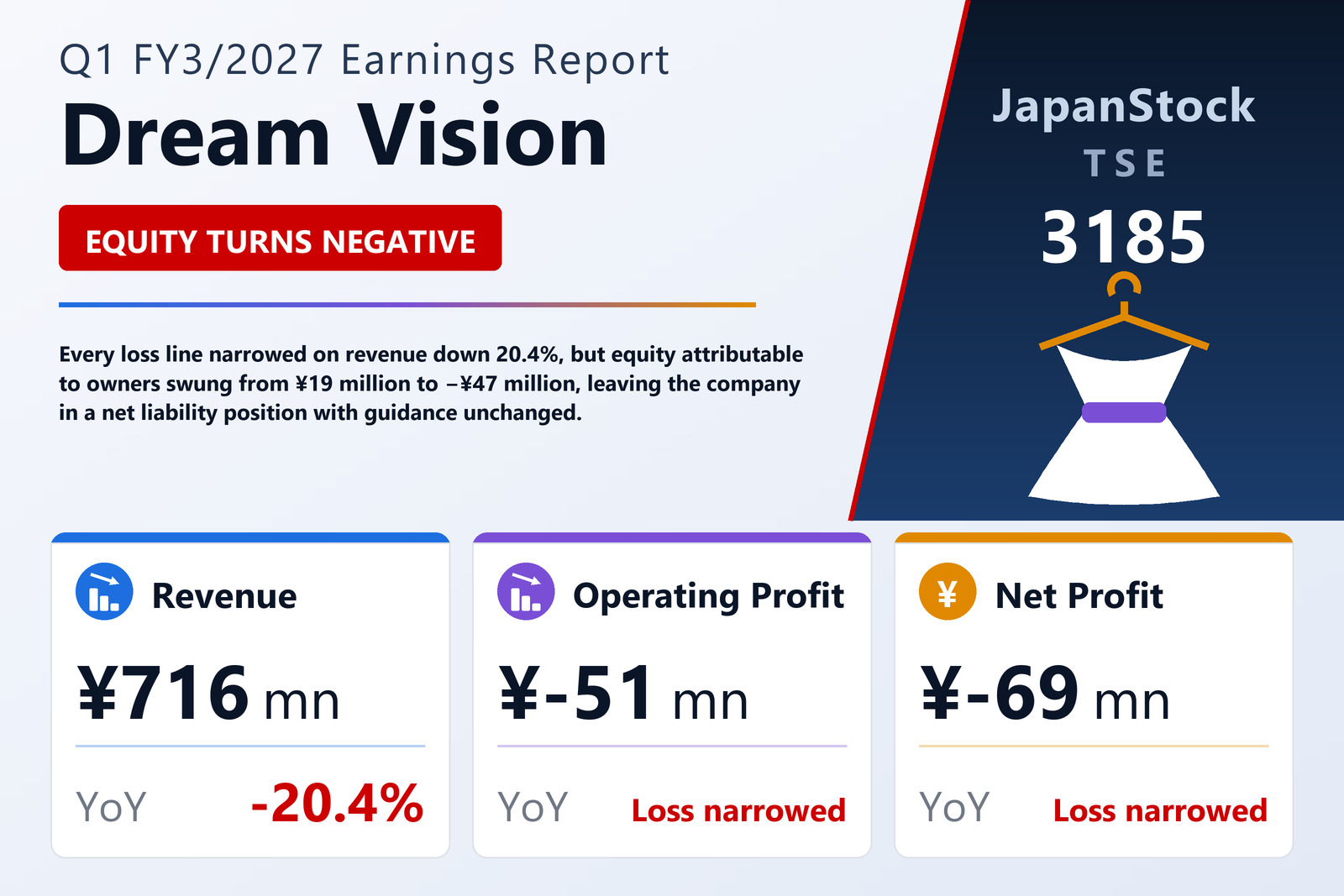
Dream Vision Co., Ltd. (TSE: 3185), which sells women's fashion mainly online and bridal jewellery mainly through stores, published consolidated results for the three months to June 30, 2026 on August 14, 2026 under IFRS. Revenue fell 20.4% to ¥716 million. The operating loss narrowed to ¥51 million from ¥62 million, the pre-tax loss to ¥70 million from ¥79 million and the loss attributable to owners of the parent to ¥69 million from ¥79 million, for a basic loss per share of ¥3.80 against ¥4.33. Total comprehensive loss was ¥68 million against ¥89 million. Every profit line improved; the balance sheet did not.
Equity attributable to owners of the parent was −¥47 million at June 30, 2026, against ¥19 million at March 31, 2026 — a fall of ¥67 million in three months that puts the group into a net liability position. Total equity is the same figure, the group carrying no non-controlling interests, and the ratio of equity attributable to owners to total assets moved to −2.6% from 1.0%. The company attributes the fall mainly to the ¥68 million comprehensive loss recorded in the quarter. Behind that single line, the accumulated deficit grew to ¥3,017 million from ¥2,947 million, against ¥1,028 million of share capital, ¥972 million of capital surplus and ¥880 million of other equity instruments — so the deficit has now consumed the whole of the group's paid-in capital base.
The filing addresses the going-concern question in two separate places, and they do not say the same thing. Note 1 to the condensed statements, headed "Notes on the going-concern assumption", reads in full: not applicable. There is no going-concern note. But section 1(4) of the management discussion, headed "material events relating to the going-concern assumption", states that because the group again recorded an operating loss and a quarterly loss and has entered a net liability position, events or conditions exist that raise significant doubt about the going-concern assumption, continuing from the previous fiscal year. The company then says it expects those conditions to be resolved or improved by continuing to rationalise selling, general and administrative expenses, to improve operating efficiency and cash flow, and to receive continued funding support from its parent company — and concludes on that basis that no material uncertainty over the going-concern assumption is recognised. The parent is not named anywhere in the filing, and no amount, term or committed facility is disclosed. The quarterly consolidated statements were not reviewed by a certified public accountant or an audit corporation.
Four fifths of the revenue decline is a business the group switched off
Revenue fell ¥184 million, from ¥900 million to ¥716 million, and most of that has nothing to do with fashion. External revenue in the Other segment — which from this quarter contains the toy business, moved out of the reportable segments because its quantitative significance had fallen — collapsed 96.8% to ¥5 million from ¥159 million of external revenue; on the company's own basis, which counts inter-segment sales, the fall is 97.1%. That ¥154 million is 84% of the group's ¥184 million revenue decline. The company explains it plainly: in the previous fiscal year it revised trading terms with a principal counterparty, stopped taking new orders and wound existing transactions down in sequence, so the toy business is temporarily suspended. Its ¥25 million of segment profit a year ago became a ¥9 million loss, a ¥34 million swing that almost exactly cancelled the improvement in apparel. Strip it out and the two continuing reportable segments fell 3.6% and 5.1% — a soft quarter, not a collapse.
Apparel is within a rounding error of breakeven, and China is why
Apparel revenue fell 3.6% to ¥549 million, but its segment operating loss came in at ¥958 thousand — ¥0 million as the company presents it — against ¥48 million a year earlier, a ¥48 million improvement on ¥21 million less revenue. The segment covers the parent company's own internet-led business, the consolidated subsidiary Naracamicie Japan (ナラカミーチェジャパン株式会社), which runs both physical and online stores, and the overseas subsidiary in Shenzhen. Domestically the company describes an explicit switch from pursuing sales scale to prioritising profitability: closing unprofitable stores, right-sizing headcount and reviewing selling, general and administrative expenses including advertising. It also says it worked down stagnant inventory carried over from the prior year, and that new products launched during the quarter under the Rose and bohmal labels sold well and lifted the gross margin. At Naracamicie Japan, fewer stores and fewer brands cut revenue, but lower fixed costs and more efficient store operations improved the result.
The growth the company points to is in China, which it designates a growth market. It says it ran a combined social-media, e-commerce, live-commerce and physical-store campaign around its main brand DearMyLove, adding new stores in Chengdu and Shenzhen on top of its Shanghai presence; sales at the new stores were strong, and both revenue and profit in the China business expanded, contributing to the apparel segment's improvement. No figure is attached to any of this — the filing discloses no geographic breakdown — so the size of the China contribution cannot be checked against the segment total, and the reader is asked to take the direction on the company's word.
Jewellery raised its average ticket and lost customers
Jewellery, run through the consolidated subsidiary Trecenti (株式会社トレセンテ), sells engagement and wedding rings to order through department stores, fashion buildings and street-level shops in major cities from Sapporo to Fukuoka, and through its own e-commerce site. Revenue fell 5.1% to ¥162 million and the segment loss widened to ¥22 million from ¥18 million — the only reportable segment moving the wrong way on profit. The company says gold and platinum prices stayed at high levels, and that staged selling-price revisions and better service quality pushed the average spend per customer up; but consumers stayed cautious in the face of general price rises and store-visit bookings failed to grow, so customer numbers fell and revenue with them. Cost savings from earlier store closures and advertising cuts had begun to show, it says, but not enough to cover the lost revenue.
The margin improved as the top line shrank; the debt did not
What is left behind is a more profitable mix. Cost of sales fell 33.1% against a 20.4% revenue decline, so gross profit fell only 7.2% to ¥409 million and the gross margin rose to 57.1% from 49.0% — the clearest single sign that the profitability-first policy is doing something. Selling, general and administrative expenses fell 9.0% to ¥467 million from ¥513 million: ¥46 million of savings against ¥32 million of lost gross profit, which is essentially the whole of the ¥10 million improvement in the operating loss. Below the operating line nothing helped. Finance income more than halved, to ¥2.7 million from ¥6.3 million, while finance costs held at ¥21.5 million against ¥23.3 million, so the net finance charge grew to ¥18.8 million from ¥16.9 million even as the operating loss shrank.
That charge is the price of the balance sheet. Interest-bearing debt totalled ¥1,330 million at June 30 — ¥1,170 million of it current, ¥161 million non-current — against total assets of ¥1,852 million and cash and deposits of ¥489 million, down from ¥629 million. Operating cash flow was an outflow of ¥112 million against an outflow of ¥7 million a year earlier; investing was an outflow of ¥10 million against a ¥58 million inflow last year, and financing an outflow of ¥20 million on loan and lease repayments. Inventories were roughly flat at ¥654 million, close to a full quarter of revenue, and the group also carries ¥200 million of short-term loans to related companies, unchanged over the quarter.
Guidance is unchanged, and it needs the operating line to turn
Full-year FY3/2027 guidance is unchanged from the forecast published on May 14, 2026: revenue of ¥3,400 million (−3.8%), an operating loss of ¥30 million, a pre-tax loss of ¥107 million and a loss attributable to owners of the parent of ¥107 million, for a loss per share of ¥5.82. Set against the quarter just reported, that guidance has an awkward shape. The ¥51 million operating loss already booked in the first quarter exceeds the ¥30 million guided for the whole year, so the remaining nine months have to deliver roughly ¥21 million of operating profit for the forecast to hold. On the bottom line the ¥69 million loss attributable to owners is about 64% of the ¥107 million guided for the year, leaving ¥38 million across the remaining three quarters — which is consistent with the roughly ¥19 million a quarter of net finance cost the group is currently running only if the operating line does turn positive. Revenue of ¥716 million is 21% of the ¥3,400 million guided, against 25% of the year elapsed. The company left the numbers alone and offered no explanation of the phasing.
No dividend is forecast: ¥0.00 for FY3/2027, as for FY3/2026, with no revision to the dividend forecast and no payment start date. After the quarter end the company issued 26,400 new shares at ¥148 each as restricted-stock compensation, resolved by the board on June 23, 2026 and paid in on July 17, 2026 — 23,500 shares to one director excluding audit-committee members, and 2,900 shares to two outside directors who are audit-committee members. The total raised, ¥3.9 million, is under a tenth of the ¥47 million equity deficit and adds 0.14% to the 18,366,100 shares outstanding. It is a compensation issue, not a recapitalisation, and the filing discloses no capital measure that would by itself restore positive equity.
| Metric | Q1 FY3/2027 | Q1 FY3/2026 | Change |
|---|---|---|---|
| Revenue (¥ million) | 716 | 900 | −20.4% |
| Gross profit (¥ million) | 409 | 441 | −7.2% |
| Gross margin | 57.1% | 49.0% | +8.1 pt |
| SG&A expenses (¥ million) | 467 | 513 | −9.0% |
| Operating profit (¥ million) | −51 | −62 | loss narrowed |
| Pre-tax profit (¥ million) | −70 | −79 | loss narrowed |
| Net profit attrib. to owners of parent (¥ million) | −69 | −79 | loss narrowed |
| Comprehensive income (¥ million) | −68 | −89 | loss narrowed |
| EPS (¥) | −3.80 | −4.33 | loss narrowed |
| Apparel — revenue (¥ million) | 549 | 570 | −3.6% |
| Apparel — segment profit (¥ million) | −0 | −48 | loss narrowed |
| Jewelry — revenue (¥ million) | 162 | 170 | −5.1% |
| Jewelry — segment profit (¥ million) | −22 | −18 | loss widened |
| Other — revenue (¥ million) | 5 | 159 | −96.8% |
| Other — segment profit (¥ million) | −9 | 25 | profit to loss |
| Total assets (¥ million) | 1,852 | 1,925 | −3.8% |
| Cash and deposits (¥ million) | 488 | 629 | −22.3% |
| Interest-bearing debt (¥ million) | 1,330 | 1,308 | +1.7% |
| Net assets (¥ million) | −47 | 19 | n.m. |
| Equity attrib. to owners of parent (¥ million) | −47 | 19 | n.m. |
| Equity ratio | −2.6% | 1.0% | −3.6 pt |
| FY3/2027 guidance — revenue (¥ million) | 3,400 | — | −3.8% |
| FY3/2027 guidance — operating profit (¥ million) | −30 | — | n.m. |
| FY3/2027 guidance — pre-tax profit (¥ million) | −107 | — | n.m. |
| FY3/2027 guidance — net profit (¥ million) | −107 | — | n.m. |
| FY3/2027 guidance — EPS (¥) | −5.82 | — | n.m. |
| Annual dividend per share (¥) | 0.00 | 0.00 | unchanged |
JapanStockPulse provides informational content only and does not constitute investment advice. Figures are taken from the company's published earnings short report and may be subject to subsequent revision.