Revenue held its ground; gross profit did not
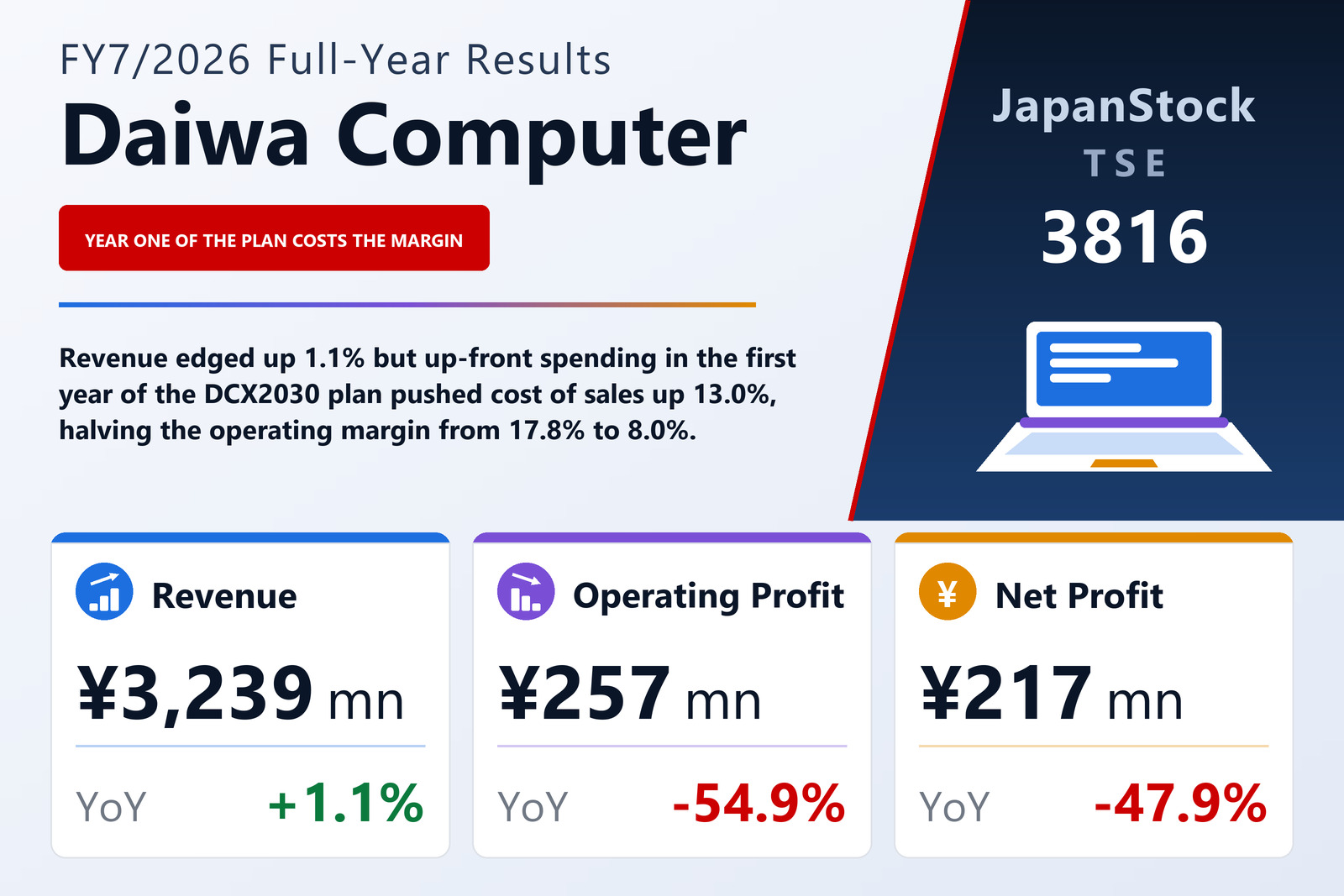
Daiwa Computer Co., Ltd. (TSE: 3816), the Osaka-based software developer and service integrator, published consolidated results for the year to July 31, 2026 on September 4, 2026 under Japanese GAAP. Revenue rose 1.1% to ¥3,239 million, but cost of sales rose 13.0% to ¥2,432 million, so gross profit fell 23.3% to ¥806 million from ¥1,052 million. Selling, general and administrative expenses rose a further 14.2% to ¥549 million. Operating profit therefore fell 54.9% to ¥257 million, ordinary profit 50.1% to ¥309 million and net profit attributable to owners of the parent 47.9% to ¥217 million, for earnings per share of ¥56.17 against ¥107.73. Return on equity halved to 4.0% from 8.0%.
The company presents this as a planned year rather than a shortfall. Revenue, it says, ran broadly in line with plan; on profit, the strategic investment set out in the DCX2030 medium-term plan — which covers FY7/2026 through FY7/2030, so this was year one — was carried out as scheduled and the result came in at the level originally assumed. The up-front costs of that investment are what the filing names as the cause of the ¥246 million fall in gross profit. Comprehensive income was ¥272 million, down 19.3%, and the filing reports no material subsequent events.
Both reporting segments grew revenue and lost profit
Software Development-related, at 76% of revenue, grew revenue 2.9% to ¥2,467 million on firm order intake, but segment profit fell 39.4% to ¥277 million: as in the prior year, the mix carried a high proportion of support-type engagements taken on with a view to winning future contract-development work. Service Integration, the group's SaaS-based software services business, also grew revenue on firm orders — 2.4% to ¥594 million — but its profit fell 77.5% to ¥29 million as headcount additions raised personnel costs and the strengthening of the delivery organisation raised outsourcing costs. The residual Other category, which is not a reporting segment and covers system sales and sales of agricultural produce from the group's smart-agriculture work, shrank revenue 21.6% to ¥177 million and widened its operating loss to ¥47 million from ¥15 million.
Below the operating line, dividends and currency do the work
Ordinary profit exceeds operating profit in both years, and by more this year. Non-operating income of ¥58 million (+8.9%) against non-operating expense of ¥6 million added ¥51 million to the ¥257 million operating result, so 16.7% of ordinary profit came from below the operating line, against 7.7% a year earlier. The composition changed as well: dividend income of ¥20 million, foreign-exchange gains of ¥16 million, interest income of ¥7 million, rent received of ¥4 million and ¥8 million of other items make up this year's figure, while the ¥26 million gain on sale of investment securities that helped last year did not recur. On the expense side, ¥4 million was a loss on investment-partnership holdings and ¥1 million a levy under the disabled-employment quota system; interest paid was ¥0.1 million. Tax expense fell 54.6% to ¥91 million.
A balance sheet that is 86.7% equity
Total assets rose 2.9% to ¥6,421 million: cash and deposits fell ¥100 million, while trade receivables and contract assets rose ¥57 million and investment securities ¥165 million. Liabilities fell 2.2% to ¥857 million — bonus provisions up ¥38 million and retirement-benefit liabilities up ¥16 million, against ¥78 million less income tax payable. Net assets rose 3.7% to ¥5,564 million and the equity ratio improved to 86.7% from 86.0%, with net assets per share of ¥1,435.90 against ¥1,384.46. There are no non-controlling interests, so shareholders' equity and net assets are the same figure, and cash and deposits of ¥3,850 million account for 60% of the balance sheet.
Operating cash flow halved to ¥141 million from ¥277 million: ¥309 million of pre-tax profit and ¥41 million of depreciation, against a ¥66 million build in receivables and ¥187 million of income tax paid. Investing used ¥127 million, of which ¥151 million was the purchase of investment securities. Financing used ¥80 million, ¥73 million of it the dividend. Cash and equivalents ended the year at ¥3,700 million, ¥50 million lower.
Guidance assumes only a partial recovery, and the dividend stays at ¥19.00
For FY7/2027 the company guides revenue of ¥3,358 million (+3.7%), operating profit of ¥268 million (+4.0%), ordinary profit of ¥308 million (−0.3%) and net profit of ¥201 million (−7.3%), for earnings per share of ¥52.10. This is not a call for a return to FY7/2025 levels: guided operating profit is less than half the ¥571 million earned two years ago, and because the guided gap between ordinary and operating profit is ¥40 million against ¥51 million this year, ordinary and net profit are guided lower even as operating profit rises. The half-year plan is revenue of ¥1,593 million (+2.7%), operating profit of ¥74 million (+11.2%), ordinary profit of ¥92 million (+2.5%) and net profit of ¥60 million (+8.1%), for EPS of ¥15.72 — leaving ¥194 million, 72% of the year's operating profit, to the second half. The company says it has again built strategic investment for medium- and long-term corporate value into the profit line.
The dividend is held at ¥19.00 per share for a third consecutive year, all of it a year-end payment; the articles permit an interim dividend but the interim is 0.00 again in the FY7/2027 plan. The total payout is ¥73 million, and because profit fell the payout ratio rose from 17.6% to 33.8%, guided to 36.5% next year. Payment begins on October 29, 2026, following the annual general meeting on October 28. The company's stated policy is to keep the dividend stable without being swayed by short-term earnings swings, and it says it intends to maintain the ¥19 level in FY7/2027.
| Metric | FY7/2026 | FY7/2025 | Change |
|---|---|---|---|
| Revenue (¥ million) | 3,239 | 3,204 | +1.1% |
| Gross profit (¥ million) | 806 | 1,052 | −23.3% |
| SG&A expenses (¥ million) | 549 | 481 | +14.2% |
| Operating profit (¥ million) | 257 | 571 | −54.9% |
| Operating margin | 8.0% | 17.8% | −9.8 pt |
| Non-operating income (¥ million) | 58 | 53 | +8.9% |
| Ordinary profit (¥ million) | 309 | 619 | −50.1% |
| Net profit attrib. to owners of parent (¥ million) | 217 | 417 | −47.9% |
| Comprehensive income (¥ million) | 272 | 338 | −19.3% |
| EPS (¥) | 56.17 | 107.73 | −47.9% |
| Return on equity | 4.0% | 8.0% | −4.0 pt |
| Software Development-related — revenue (¥ million) | 2,467 | 2,397 | +2.9% |
| Software Development-related — segment profit (¥ million) | 277 | 457 | −39.4% |
| Service Integration — revenue (¥ million) | 594 | 580 | +2.4% |
| Service Integration — segment profit (¥ million) | 29 | 130 | −77.5% |
| Other — revenue (¥ million) | 177 | 226 | −21.6% |
| Other — segment profit (¥ million) | −47 | −15 | loss widened |
| Total assets (¥ million) | 6,421 | 6,241 | +2.9% |
| Net assets (¥ million) | 5,564 | 5,365 | +3.7% |
| Equity ratio | 86.7% | 86.0% | +0.7 pt |
| Net assets per share (¥) | 1,435.90 | 1,384.46 | +3.7% |
| Operating cash flow (¥ million) | 141 | 277 | −49.1% |
| Cash and equivalents at year end (¥ million) | 3,700 | 3,750 | −1.3% |
| Annual dividend per share (¥) | 19.00 | 19.00 | unchanged |
| Dividend payout ratio | 33.8% | 17.6% | +16.2 pt |
| FY7/2027 guidance — revenue (¥ million) | 3,358 | — | +3.7% |
| FY7/2027 guidance — operating profit (¥ million) | 268 | — | +4.0% |
| FY7/2027 guidance — ordinary profit (¥ million) | 308 | — | −0.3% |
| FY7/2027 guidance — net profit (¥ million) | 201 | — | −7.3% |
| FY7/2027 guidance — EPS (¥) | 52.10 | — | −7.2% |
JapanStockPulse provides informational content only and does not constitute investment advice. Figures are taken from the company's published earnings short report and may be subject to subsequent revision.